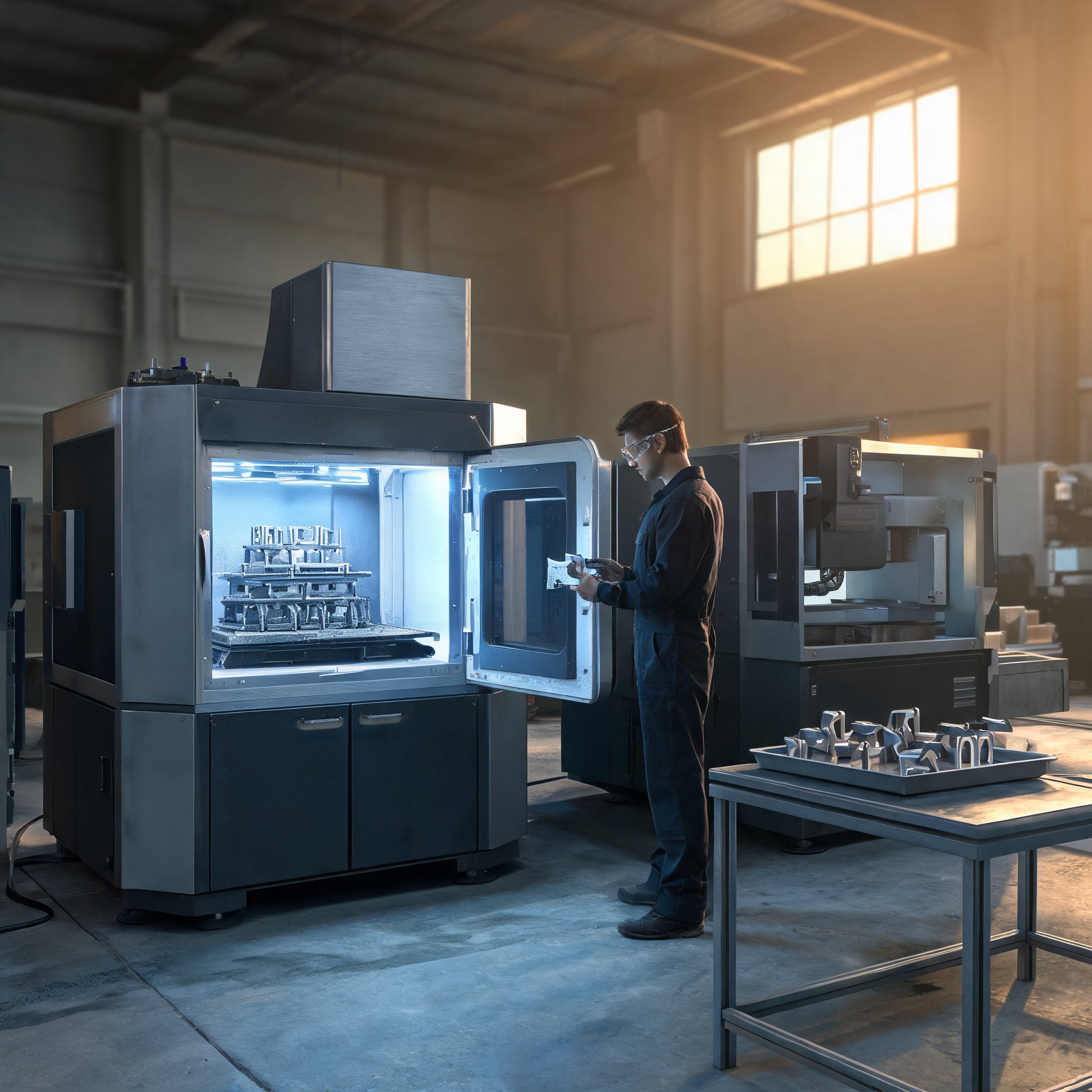
Ahead of Formnext 2026 in Frankfurt, where the UK is partner country from 17 to 20 November, British additive manufacturing brings an enviable research base and an unresolved commercial question. The country that helped invent industrial mass production still hosts strong materials science and machine design; whether that becomes production volume, repeat orders and trained operators is what founders keep debating.
A buyer that knew what it wanted
Portsmouth offers the historical case. Henry VII ordered a dry dock there in the 1490s, and during the Napoleonic Wars the Royal Navy bought about 100,000 wooden pulley blocks a year, a single ship such as HMS Victory needing more than a thousand. In 1803 the first block-making machines designed by Marc Isambard Brunel and built by Henry Maudslay began work at the dockyard; that May the Admiralty approved a second set for smaller blocks, and by 1808 45 machines were producing 130,000 blocks.
The invention takes the credit, but the buyer's discipline mattered as much: the Navy knew which sizes it used and in what quantities, and could watch the first machines run before committing to the next set. Machine builders describe the same appetite now, and one founder reckons two more installations would ease his next financing round.
Counting inventions, not output
British invention is well documented. The European Patent Office counted 1,925 international patent families in additive manufacturing originating in the UK between 2001 and 2020, close to France's 1,938. In its 2026 annual plan, Additive Manufacturing UK put the UK market at £515m to £740m in 2024, or 3% to 4.3% of the global total, a range reflecting disagreement between estimates. Neither figure says how much of the resulting production happens in Britain.
Will Richardson, chief executive of Wayland Additive, points to metallurgy and materials science at Sheffield, Birmingham, Cambridge and Oxford and to the Henry Royce Institute, which links expertise across institutions. His company grew out of a team with electron-beam experience in semiconductors. In October a Calibur3 metal system left its Huddersfield site for the University of Innsbruck, where researchers will study difficult materials, including ones for high temperatures. Britain built and exported the machine; part of the knowledge of what it can do accumulates in Austria.
- Alloyed, rooted in Oxford materials research, licensed a cast nickel alloy to Hitachi Metals in 2018 and later opened component development and production in Abingdon and Seattle, selling its first flight parts from Seattle in 2023.
- Craig Pyser, chair of Additive Manufacturing UK and chief executive of AMufacture, calls Britain's share respectable for the size of its economy while acknowledging the old complaint that British engineers invent what others sell.
After the grant closes
Jake Hand, co-founder of Exeter-based Rapid Fusion, which grew out of distributor Evo 3D and now builds large-format systems, says the business is profitable without research funding and credits Innovate UK with letting it develop its own technology. His complaint concerns the moment a project works: "they back a project, but not a business." A finished machine answers the funder's questions; the customer still asks whether it can make a particular mould, who trains the operator and what happens if the machine stops mid-job. Answering that for one sale can take months. Innovate UK does fund customer validation and initial tooling but not general business costs, and Pyser calls applying "excruciatingly difficult."
Kingston University offers one answer. Operations manager Lesley Stigling says a graduate named Raghav joined Rapid Fusion and insisted his employer and his old department meet, producing a £450,000 Zeus robotic cell at Roehampton Vale that combines large-format printing with CNC milling. The university can bring work in-house and teach on it; the manufacturer gains a reference installation.
Equity and the first investor
John Robinson, additive manufacturing research commercialisation manager at the University of Wolverhampton, incorporated a company in May 2017 that funded his PhD and says he and the university filed several patent applications together in 2024; his work now includes multi-material devices that carry heat away from data-centre equipment. He recalls the former technology transfer office wanting 75% of the company, while later talks with the enterprise team concerned a potential 10% stake. Both were proposals, and the sector has been moving: the Royal Academy of Engineering and Dealroom found that, among UK deep-tech hardware spin-outs in their sample, the average non-cash stake universities took fell from 25% in 2015-19 to 14% in 2024-25, on partial 2025 figures.
Louis Masters has crossed the first threshold. Hydra Manufacturing, a Leeds spin-out developing equipment for technical ceramics, announced £320,000 led by SFC Capital in March, taking total support including earlier grants to about £577,000, and was weighing around £1m or more. Investors want to see two more installations, and winning them consumes the capital he is raising. Germany, with its concentration of advanced ceramics makers, is the natural first market; where those customers sit will shape which applications his team develops.
Doing the doing
Richardson names a constraint the commercialisation debate often skips: "if you're not actually doing the doing, then you're not going to get good at it." A limited installed base of industrial equipment in Britain, and in some of Wayland's markets a shortage of major customers willing to put work through it, shows up in hiring. A CNC machinist can learn an additive system, but only where several factories run the equipment can an employer hire someone who already knows how to prepare builds and keep a machine productive.
Jason Hutt, managing director of Fastech, states the incumbent's advantage plainly: "Casting's approved, isn't it?" A customer already buys a casting to an agreed specification, while a printed replacement may pass material tests and still need evidence tied to a particular machine, process and grade, and a second buyer may require much of the work again. That bill has to come out of orders eventually won, arithmetic that differs sharply between fifty parts and five thousand. The £38m, Airbus-led DECSAM programme, with Renishaw, GKN Aerospace, Apex and the Manufacturing Technology Centre among partners, is one attempt to share the cost in civil aerospace, planning ground and flight demonstrators and qualification guidance.
Where the customers are
Jason Bowes, chief operating officer of CloudNC, which writes AI-assisted software for programming CNC machines and tests it in its own British factory, told a Manufacturing Technologies Association briefing at the House of Lords on 12 November that "it's far, far easier to sell our technology in the U.S. than it is here." Hand also finds American buyers quicker to reinvest. A cautious purchasing manager may still be reasoning correctly: a shop with an uncertain order book must cover machines it already owns, and a lower cost per part at full utilisation helps little if only a fraction of hours can be filled.
AMufacture's mix shows what changes when demand is concrete. Pyser estimates 95% to 98% of its work is production, having started in marine; defence has become the largest sector over the past year. Some defence customers revise designs every six to eight weeks, so a drawing may change before conventional tooling is ready, while other buyers arrive with requirements such as a delivery specialist with at least ten years' experience, system integration, traceability and an answer when a batch fails inspection. One customer took some production in-house with AMufacture's help and kept ordering; two years later it sold the printer back, software, staff and post-processing having made the in-house operation dearer than expected.
What procurement can buy
James Selka, chief executive of the Manufacturing Technologies Association, told the same briefing that investment was poised to enter British manufacturing but needed "a proper demand signal and co-investment from government," putting energy prices first among immediate obstacles. Lord Harrington of Watford, chair of Make UK, recalled that sector deals under Theresa May worked where firms could match public money, as in aerospace and life sciences, and that elsewhere some companies government wanted to encourage could barely afford their share. He chaired GeoPura, a north-east hydrogen business that sought capital in Britain and was sold to Canada's Ballard Power Systems for £275m upfront in August.
Procurement is the lever Harrington identifies, and there are recent tests. In 2025 the UK Atomic Energy Authority commissioned two additive systems at its Central Support Facility, a Freemelt electron-beam machine for tungsten and a Nikon SLM laser system supplied by Kingsbury Machine Tools with support from Additure, while British participants including Laser Additive Solutions, The Welding Institute and WAAM3D contributed to separate fusion maintenance work on inspection and repair. The authority publishes a quarterly procurement pipeline separating possibilities, pre-commercial work and confirmed requirements due to tender. The team at Added Scientific adds a caveat: an established single-material process and a multi-material device still being proven warrant different kinds of money.
Pyser has a simple test for Frankfurt. An overseas company seeking a European base and choosing Britain would count. So would smaller things, checkable in a year: whether a visitor who saw a British-built machine ordered one, and whether a first installation led to a second. The Admiralty gave Brunel his answer in May 1803; the modern equivalent is a purchase order.