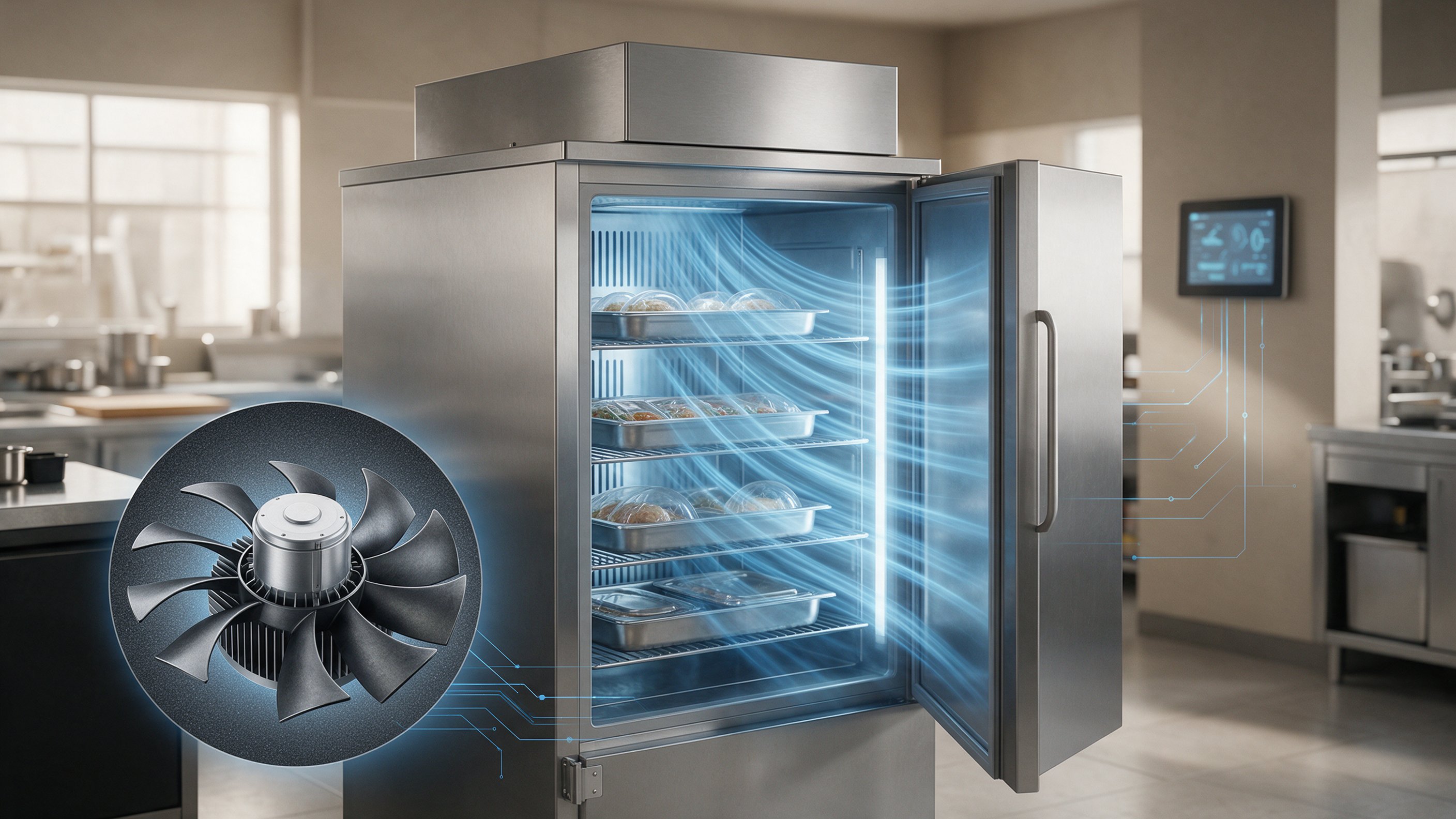
Professional refrigeration is being reshaped by three pressures at once: food-safety assurance, energy costs and stricter European product rules. Within that shift, blast chillers are no longer treated as a narrow add-on for specialist kitchens. They are increasingly positioned as a process-control point that links rapid cooling, HACCP compliance, energy performance and digital traceability.
Why rapid cooling matters
After cooking, food passes through a critical temperature band. The article describes the “danger zone” as roughly 63°C to 4°C, where microorganisms can multiply quickly. Reducing time in that range is a core HACCP principle. Blast chillers use intensive cold-air circulation to bring food from more than 70°C to below 3°C in as little as ninety minutes. That is a technical capability, not a guarantee for every load; performance depends on airflow, load arrangement and equipment design.
The operational benefits go beyond compliance. Faster cooling can limit bacterial growth, extend shelf life and help preserve texture, moisture, aroma and nutritional value. It also supports production planning and waste reduction in high-volume kitchens, hospitals, hotels, catering operations and food-processing plants. These are presented as advantages of rapid cooling, with final results dependent on correct use and maintenance.
Airflow becomes the design variable
Blast-chiller performance is often associated with the refrigeration circuit, compressor or evaporator. The article argues that actual performance depends heavily on how cold air reaches the load. Heat transfer is effective only when airflow is uniform across the entire batch. Low-velocity zones or turbulence can leave parts of the product cooling more slowly, creating temperature differences that may compromise safety, cooling time and final quality.
That makes the fan a strategic component rather than an accessory. EC, or electronically commutated, motors combine high electrical efficiency with continuous speed control, allowing airflow to be matched to each stage of the cooling process. When paired with biomimetic impeller designs and composite materials, the intended result is more uniform cold-air distribution and lower energy use. The article also notes reduced noise, lower heat generation, longer service life and less maintenance as design benefits of EC technology. It says such motors can replace large external controllers in some arrangements, freeing space inside the chiller, but this is described as an application advantage rather than a universal outcome.
Digital control and traceability
Digitalization adds another layer. Modern blast chillers can select programs by food type, monitor temperature through probes and record the process for traceability. That record is useful in food-safety audits and supports HACCP protocols. Open communication protocols such as Modbus allow units to connect with kitchen infrastructure and building management systems. Remote monitoring and predictive maintenance can then use parameters such as temperature, fan speed, operating hours and energy consumption to detect deviations before they become failures. The article presents this as a way to reduce maintenance cost and improve availability, while recognizing that integration depends on compatible systems and proper commissioning.
Europe’s regulatory push
The European Union is tightening requirements on energy use and carbon emissions, and the Ecodesign framework is broadening beyond energy performance alone. The article points to durability, repairability, digitalization and system-level efficiency as emerging criteria. The Ecodesign for Sustainable Products Regulation (ESPR) is described as a turning point for the next generation of equipment. Many measures will arrive progressively, but the 2026 horizon is already influencing manufacturers and engineering firms.
The practical implication is that efficiency can no longer be pursued only through the refrigeration circuit. Motors, fans, heat exchangers and electronic controls all affect whether an installation meets market and regulatory expectations. This shifts design from maximizing cooling capacity alone to optimizing the performance of the whole system.
From components to system performance
The article cites ZIEHL-ABEGG as an example of this evolution. Its EC axial fans for commercial refrigeration and food service are described as combining high-efficiency motors, aerodynamic design, low noise and open-protocol communication for integration into intelligent energy management. The broader point is not a single product claim but a design logic: the overall efficiency of a blast chiller depends on the combined performance of its parts, and laminar distribution of cold air can deliver faster, more even cooling while reducing the equipment’s carbon footprint over its service life.
This also changes industry roles. Manufacturers must keep investing in equipment that can meet tighter rules. Installers need broader knowledge of electronics, connectivity and control systems, because customers now expect lower operating costs and high reliability as well as cooling capacity. Intelligent components, remote monitoring and predictive maintenance can turn installation professionals into technology advisers across the equipment lifecycle—provided the skills and service models keep pace.
What the shift means
The direction is clear: professional refrigeration is moving toward equipment that is more efficient, connected and sustainable. Blast chillers illustrate the change because they combine food safety, automation and energy performance in one process. Food safety remains the primary objective, but meeting it increasingly depends on an integrated approach in which airflow, digital records, efficient motors and regulatory design criteria are considered together. The next generation of equipment will be judged not only on how quickly it produces cold, but on how consistently and efficiently it does so.