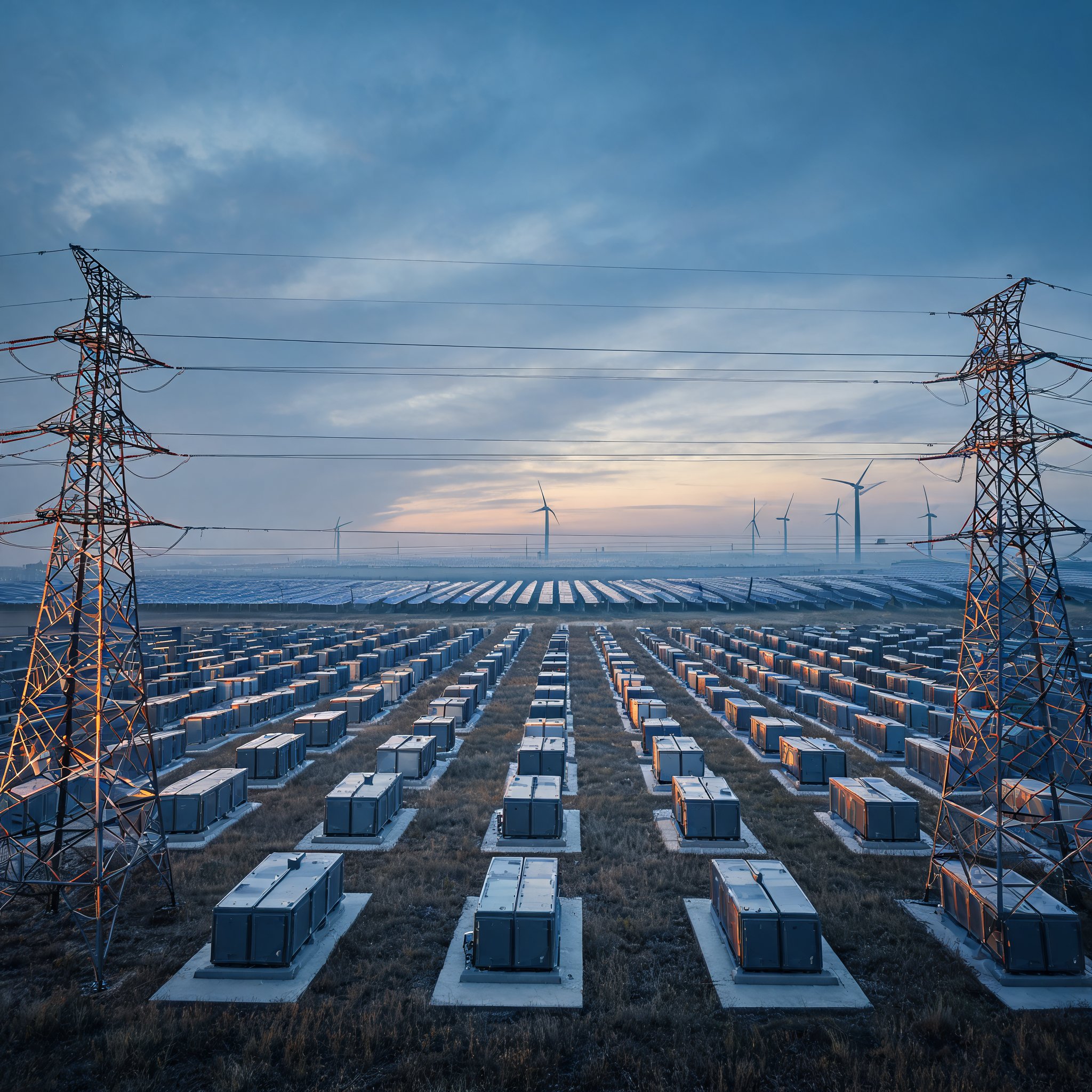
China's operational new-type energy storage capacity reached 167 GW/435 GWh at the end of September 2026, 63% above the level of a year earlier, according to figures the National Energy Administration (NEA) presented at its quarterly press conference on national energy development on October 30.
The agency's new-type category covers electrochemical batteries, compressed-air systems and other emerging technologies but leaves out conventional pumped hydro. The headline total therefore describes the newer part of the country's storage base rather than the whole of it, and the 63% growth rate compares like with like on that definition.
More megawatts, and more hours per megawatt
Set against 135.93 GW/351.12 GWh at the end of 2025, the September figure implies a net addition of about 31 GW/84 GWh during the first nine months of 2026.
The configuration numbers moved too. Average storage duration reached 2.61 hours, roughly 0.27 hours longer than a year earlier, and equivalent utilization hours across the nine months came to about 915, some 10 hours above the same period of 2025.
Duration is the ratio of a fleet's energy to its power, so a rising average means additions are bringing more hours of storage per megawatt than the units already in place, or that shorter-duration units now make up a smaller share. Utilization speaks to how heavily assets are called on. Both moved in the same direction, but by modest amounts, which points to gradual change in how the fleet is configured and operated rather than a step change.
The renewable backdrop
The NEA tied the build-out to policy support, technical innovation, domestic supply chains and rising demand for flexibility. The renewable backdrop is the main driver: combined wind and solar generating capacity passed 2.01 TW by the end of September, about 48.7% of total installed power capacity.
As variable output expands, storage is used to absorb surplus electricity in high-generation periods, to shift supply toward hours of greater demand and to provide fast-response grid services. Those roles place different demands on equipment: shifting energy needs hours, while fast response needs power and control capability, so a fleet serving both has to be judged on more than one metric.
Who owns the assets, and what chemistry
Official 2025 figures show the market's composition. Independent storage facilities accounted for 51.2% of cumulative new-type installations, projects rated at 100 MW or more represented 72% of installed capacity, and systems with at least four hours of duration made up 27.6%.
Lithium-ion batteries still account for about 96% of installed new-type capacity, a concentration that reflects the maturity of that supply chain. Compressed-air, flow batteries and other options hold small shares but are gradually widening their presence, and the plan's emphasis on longer-duration systems gives them a reason to compete, though the current data do not yet show how much ground they have gained.
Revenue rules in transition
Market reform is expected to reinforce the trends above. China has been developing arrangements that let independent storage operators earn revenue from electricity trading, ancillary services and capacity remuneration, gradually reducing reliance on storage mandates attached to renewable projects. For a developer, the test shifts from satisfying a pairing requirement to earning enough from trading spreads, system services and capacity payments to justify the investment.
Targets, and one grid under stress
Under the 15th Five-Year Plan for power system development, new-type storage is targeted to reach 300 GW by 2030, with more weight on longer-duration systems, grid-forming capability and operational efficiency. That is a target for the next build phase, not a description of capacity in place.
Longer duration is the harder half of the objective. The 2025 split puts only 27.6% of installed capacity in systems of four hours or more, so changing the mix takes more than repeating the current installation rate.
One regional case shows what a lean toward storage looks like in operation. In western Inner Mongolia, the grid operator reported 20.23 GW/70.47 GWh of operational storage in October. During emergency dispatch, storage supplied as much as 12.25 GW, equivalent to 33% of the grid's electricity demand at that moment.
The pairing of those two numbers is itself informative. During a period of system stress it was power capacity that met a third of demand, while the energy figure attached to the fleet sets how long such support can be sustained.
What the data cannot settle
Some caution is needed. The Inner Mongolia episode was a single grid under emergency conditions, not a routine day, and it demonstrates short-term balancing capability rather than annual performance. Utilization is reported in equivalent hours, and capacity is nameplate, so power and energy should not be read interchangeably. The ownership, project-size and duration splits date from 2025 and have not been restated for the 2026 fleet, and the 300 GW figure is a 2030 objective rather than a forecast of what will be delivered.
Even so, the deployment is being watched well beyond China. For countries scaling wind and solar, the experience on offer lies in manufacturing storage at volume, integrating it into grid operations and dispatching it centrally, areas in which installed capacity figures on their own say very little.