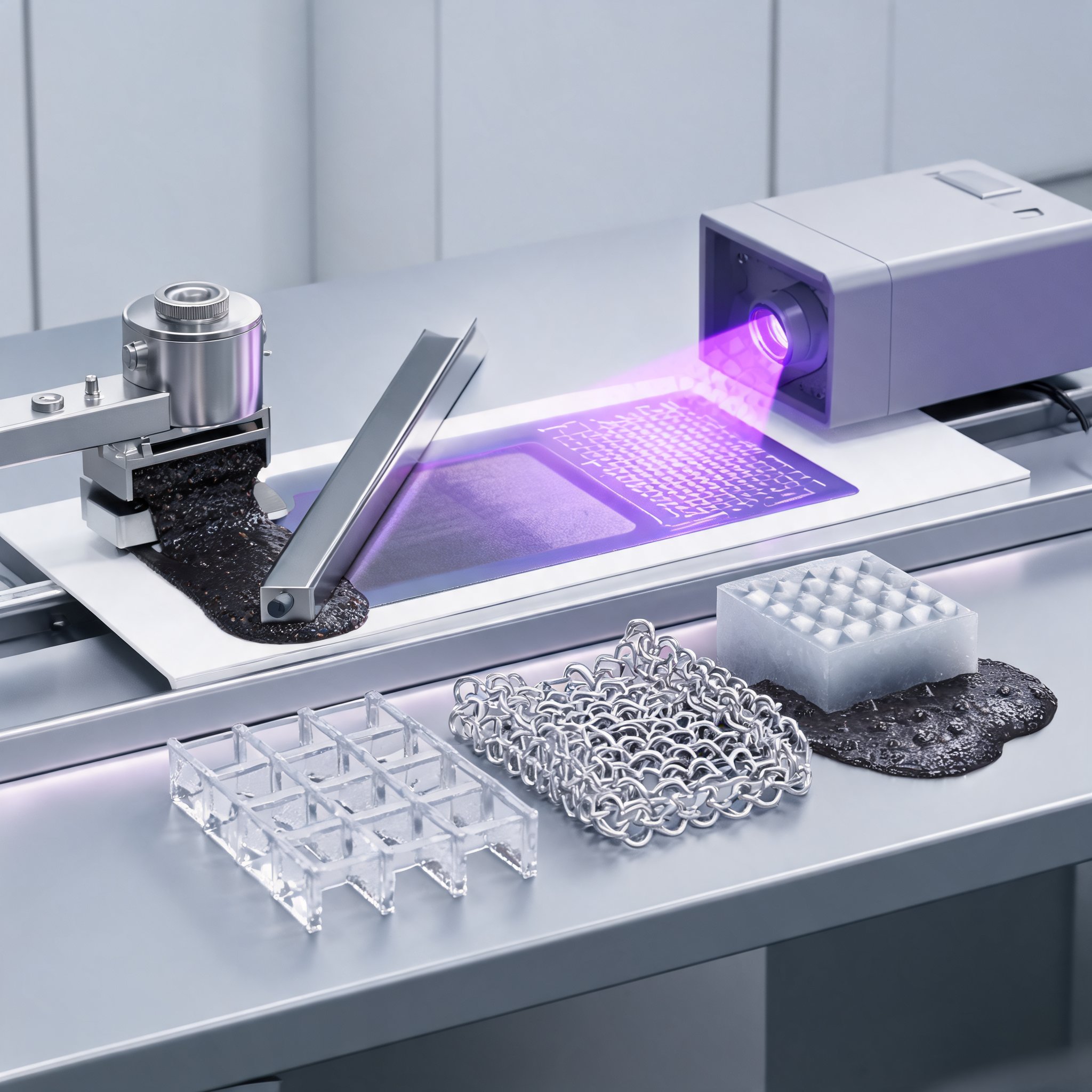
Northwestern University researchers have developed a hybrid additive manufacturing process that aims to print thick, particle-filled inks with the speed and feature control usually associated with light-based 3D printing. The method, called direct ink additive lithography (DIAL), is described in Science Advances and was led by Pranav Kaarthik.
The work addresses a split between two established approaches. Digital light processing relies on low-viscosity resins that scatter light only weakly, while direct ink writing can handle functional yield-stress inks but is slowed by filament-by-filament deposition and constrained by nozzle diameter. DIAL instead forms each layer as a thin sheet before using projected light to define solid regions.
How the process works
For every layer, a slot die extrudes ink onto a substrate. A doctor blade then spreads the deposited material into a sheet as thin as 25 microns. A 405-nanometer projector moves across that sheet and crosslinks selected areas. Ink that is not exposed remains in place and acts as support during the build.
Because the projection light only has to pass through a thin ink sheet, the process can handle opaque, heavily filled formulations. Planar resolution is set by the projector's 50-micron pixel pitch, according to the paper.
Ryan Truby, the June and Donald Brewer Junior Professor of Materials Science and Engineering at Northwestern University, said manufacturers have faced a tradeoff between the materials they need and the speed, resolution and scale they want. He framed DIAL as a foundation for removing that compromise.
Printed demonstrations and timing
Using a model ink made from a polyurethane-based resin thickened with fumed silica, the team printed a 60 mm by 40 mm log-pile structure in 30 minutes. The same structure took 124 minutes with direct ink writing, according to the paper. The researchers also produced fins about 150 microns thick.
By rastering projection across overlaid ink sheets, they made a multimaterial lattice covering four times the projector's illumination area. Other demonstrations included interlocking chain mail with struts about 250 microns thick; 15 gyroid structural electrolyte lattices printed from an ionogel ink in one 15-minute run; and hydrogel cell-culture inserts containing 0.5-mm-deep inverted pyramids.
The authors described their reported print times as conservative because tool changes had not been optimized for speed. They also noted that DIAL avoids the suction and peel forces found in vat-based printing, an equipment condition they expect to make it easier to expand build area and volume.
Scale-up path
Truby said new ways to make advanced materials will be needed to rebuild American manufacturing. Because DIAL can print many complex, functional parts at once, the team sees a route from laboratory demonstrations to larger-volume production of architected materials for robotics, aerospace, healthcare and other uses.
Kaarthik and Truby are listed as coinventors on a U.S. provisional patent application. The work received funding from the National Science Foundation, the Air Force Office of Scientific Research and Northwestern's McCormick School of Engineering.