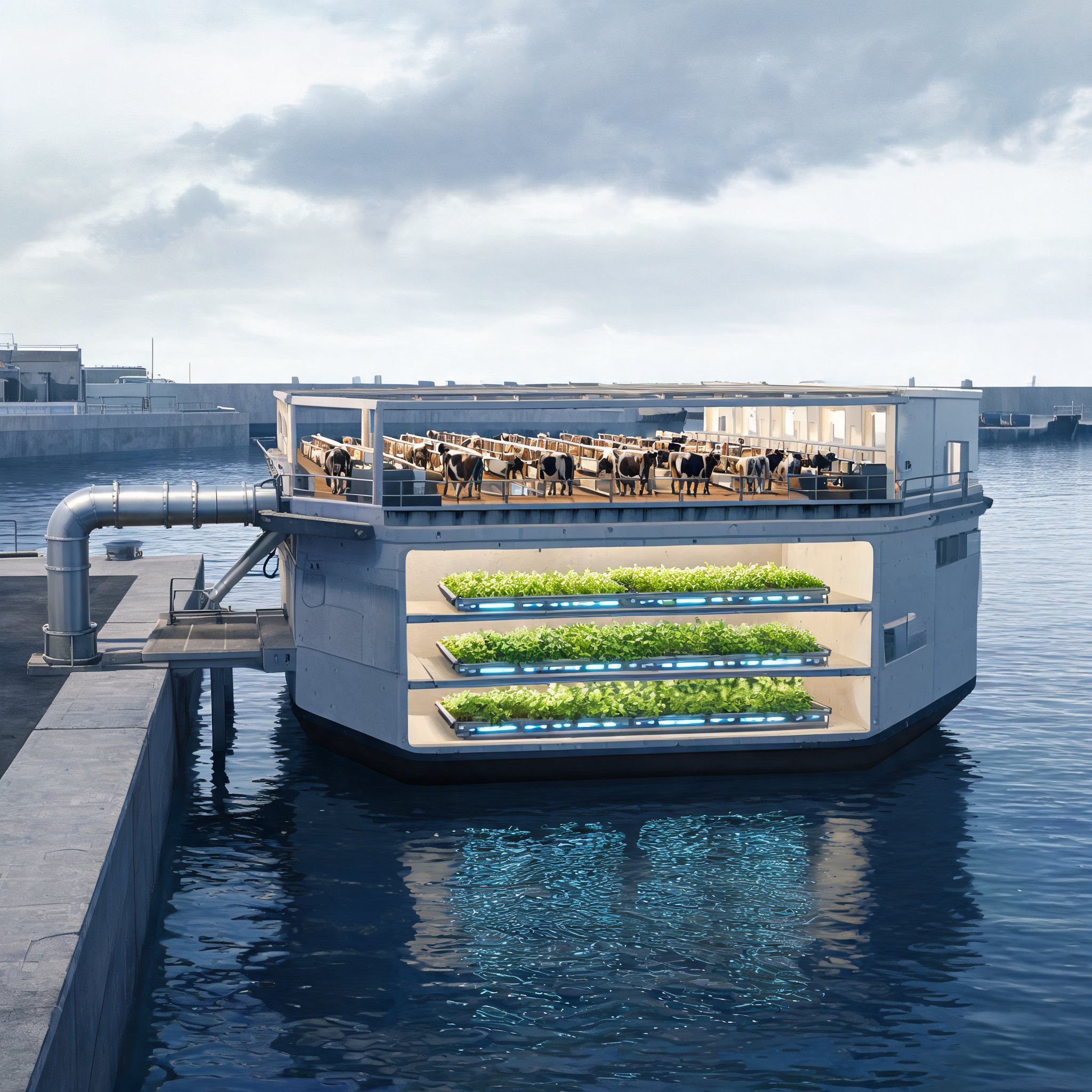
The Floating Farm in the Port of Rotterdam has reversed course on a planned sale, with its 28 Dutch MRI cows relocated to several farms about 20km away and milk production continuing under a different supply arrangement, according to co-founder Peter van Wingerden.
The farm had recently been put up for sale after a disagreement with the local environmental department, which said a newly fitted floor did not comply with regulations. At that point the cows had been removed and were due to be sold, and milk production was to stop.
Van Wingerden said the farm is no longer being sold. The cows now live on a few nearby farms, and a stainless steel pipeline runs from the quay to the floating structure. A regular dairy truck brings milk from the dairy twice a week, roughly 1,500 litres per batch, with the 20km distance keeping transport time short.
From €4m concept to port landmark
The Floating Farm was the idea of Peter and Minke van Wingerden, who invested €4 million in on-site feeding, milking, slurry handling and dairy production facilities. It opened in May 2019 as a futuristic attempt to produce food sustainably without the traditional tie to land.
Located in the port, it produced milk and dairy products for local consumers, who bought them from the farm's vending machines. The concept drew hundreds of thousands of visitors from around the world.
Vertical growing below the waterline
Van Wingerden confirmed that milk and other dairy production continue and that the vertical farm is performing well. The unit is a fully controlled, automated growing space with three layers carried on conveyor belts, combining grow-room and warehouse technology, and sits below the waterline so it is cooled by the water.
- Micro-greens are harvested every two weeks.
- Herbs every three weeks.
- Leafy greens every four weeks.
- Edible flowers every four to five weeks.
The crops are turned into tea, pesto, herb-infused salts and herb-infused whey, alongside the farm's Parmigiano cheese.
Emissions claim and a move ahead
Van Wingerden said the farm has the lowest emissions possible because of its modern technology and system, but that the rubber floor is German and has no certificate of compliance in the Netherlands. He described the current arrangement as a departure from the original vision that the team is coping with.
The Floating Farm will have to leave the port in just over two years, he said, because the entire area is to become residential.