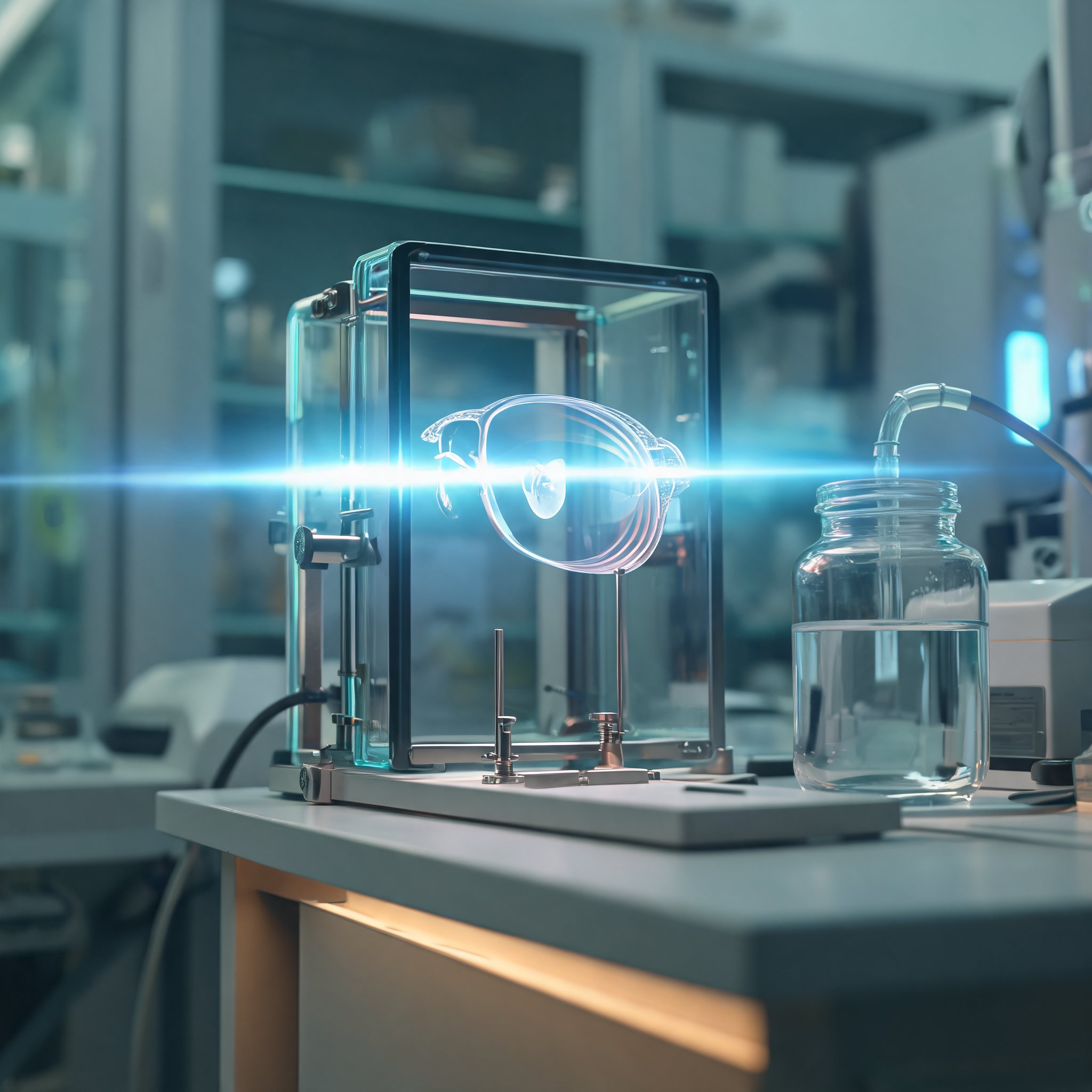
Spanish ophthalmic technology company IOT says it has become the first to 3D print personalized progressive lenses. Its Light-Form technology forms a complete lens from a single flash of light in a few seconds, and IOT says lenses made this way are already on sale to consumers. The process does not build a lens layer by layer, and it skips the generating and polishing steps used in conventional lens surfacing.
IOT also claims the method uses fewer resources than traditional lens production. Compared with conventional methods, it says Light-Form uses no water in manufacturing, needs 90% less energy and produces 76% less waste. The company notes that these figures cover the manufacturing stage only.
How the Light-Form process works
The process is based on stabilized frontal photopolymerization. A single pass of light cures the entire volume of the lens rather than shaping it gradually from a blank. That forming stage takes seconds. Finishing still follows before a lens is complete: unused resin is recovered to limit waste, the surface is hardened, and the lens is mapped.
According to IOT, a new production method for personalized progressive lenses must reproduce the intended optical design precisely, not merely produce a recognizable shape. The company says Light-Form combines the design freedom of digital manufacturing with those optical requirements, allowing additive manufacturing to produce prescription lenses at commercial optical quality. IOT adds that this could open more options for future lens architectures and individualized solutions.
José Alonso, co-founder and CINO of IOT, said the technology shows how scientific research can change the way ophthalmic lenses are made. He added that pairing optical precision with a new production method could help optical partners create personalized products, test new lens architectures and run more flexible manufacturing.
Rethinking where lenses are made
IOT presents Light-Form as a way to redesign the production chain, not just speed up forming. Larger installations could use several printing heads to raise output without taking up much floor space. Further ahead, the company envisions compact machines making custom lenses inside optical stores, putting production next to the customer and reducing the need to hold stock.
Carolina Gago, COO of IOT, said the value lies in rethinking the production workflow. She noted that resin recovery and lower water and energy requirements address how resources are used, while compact equipment could support production closer to consumers. The company says it is working to translate these capabilities into practical manufacturing options.
For optical laboratories, this could mean organizing capacity around local demand instead of relying only on centralized surfacing equipment. For wearers, IOT says the long-term benefit would be faster access to lenses made for them. IOT also says optical partners would still play the central role in vision correction and customer service.
Beyond conventional spectacles
IOT is looking beyond conventional spectacles. One option under development is printing prescription optics directly onto waveguides and flat substrates used in smart glasses and augmented reality headsets, which could make those devices thinner and lighter. The company also suggests that custom optical shapes could eventually be useful in virtual reality.
The company frames Light-Form as a change to how lens production is organized, not only a new way to form lenses. It plans to replace reliance on conventional surfacing infrastructure with production set up around local demand. It also sees in-store manufacturing as a possible way to bring personalized lenses closer to the wearer.
Other additive manufacturing projects are also targeting vision correction. Luxexcel was an early example in prescription eyewear. Conventional prescription lenses tend to be manufactured through a process of around 30 steps, requiring large inventories and producing high wastage. Luxexcel instead built lenses layer by layer in a material jetting process, and its platform could print single-vision and freeform lenses and multifocal progressive designs. It also embedded waveguides into prescription lenses for smart glasses, the same direction IOT is now exploring. Meta later acquired Luxexcel as part of its AR technology efforts.
More recently, the approach has moved into point-of-care contact lenses. A team at the University of Waterloo has developed a system that 3D prints custom contact lenses in roughly 20 minutes, raising the prospect that a patient could be measured, have a lens designed and walk out wearing it after one clinic visit. The work earned a Gold Medal at the Shanghai International Exhibition of Inventions in June 2026.
These projects show additive manufacturing moving into optical production. IOT says its personalized progressive lenses are already reaching consumers.