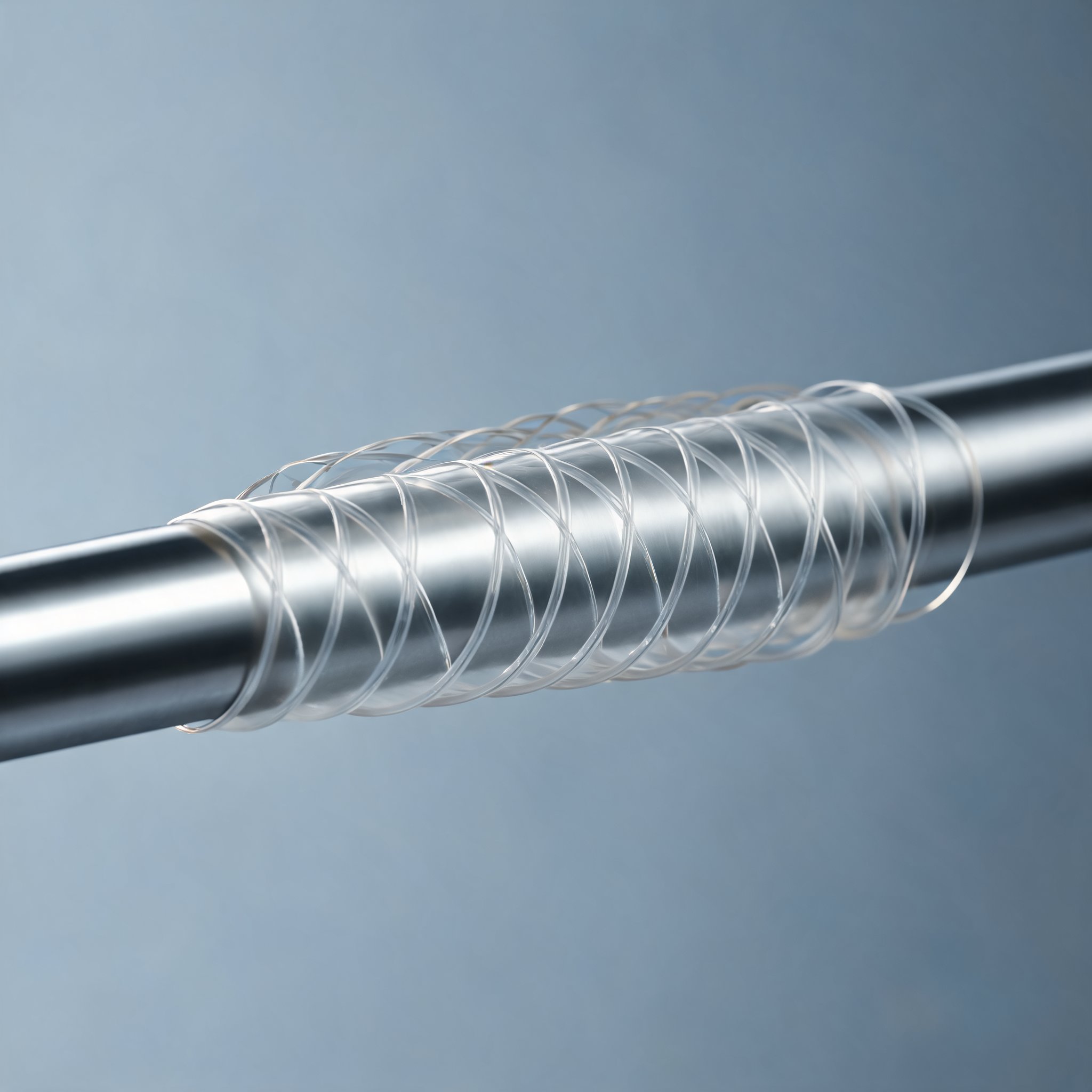
Junkosha introduced a new Wrapped Liner category of catheter liner at MD&M Midwest in Minneapolis, presenting the construction method as a distinct platform for small-format catheter designs rather than an extension of existing liner types.
The company said the category draws on decades of work in fluoropolymer technologies and applies its proprietary PTFE tape engineering and wrapping technology. In the described process, PTFE film is wrapped around a mandrel to build up the liner wall, instead of extruding a complete tube. By engineering the properties of the tape, Junkosha says it can create a liner platform designed to achieve a thin, uniform wall thickness together with high tensile strength and flexibility.
What the construction method changes
According to Junkosha, the combination is intended to give catheter designers and manufacturers greater freedom in how they configure the rest of the device. Because the liner wall can be made thin and uniform while retaining strength, engineers may be able to specify finer braid or coil wire, or reallocate space elsewhere in the catheter construction.
The company frames the balance between thin walls, strength and uniformity as the central point of the category. That balance, it says, could allow greater flexibility in how reinforcement is configured, and the Wrapped Liner line is intended as a scalable platform supporting a portfolio of solutions for evolving catheter requirements.
Steve Maxson, founder of Maxson InSight Services, said catheter engineers often describe profile as king, but argued that a low-profile design involves more than reducing wall thickness. In comments provided by Junkosha, he said a catheter still has to resist kinking and ovalization while retaining the flexibility its application requires. With extruded and film-cast liners already available in very thin walls, he said the real opportunity lies in how thin-wall construction and strength work together to change how engineers approach catheter design.
Company positions the category for 2027 and beyond
Kevin LaDow, chief sales officer of Junkosha USA Inc., said current catheter liners are typically either dip-coated PTFE built up on a mandrel or extruded PTFE supplied as tubing cut to length. He said that as the industry heads into 2027 there is a need for a new liner category that is not only manufactured differently but also offers distinct benefits for small-format catheter OEMs.
Through the approach, LaDow said, Junkosha aims to extend the possibilities of catheter design to support next-generation medical devices intended to enhance flexibility and broaden the range of anatomies that can be accessed and treated.
The Wrapped Liner platform is being presented as a category-level concept, with the company describing it as a base for a growing portfolio rather than a single finished product line.