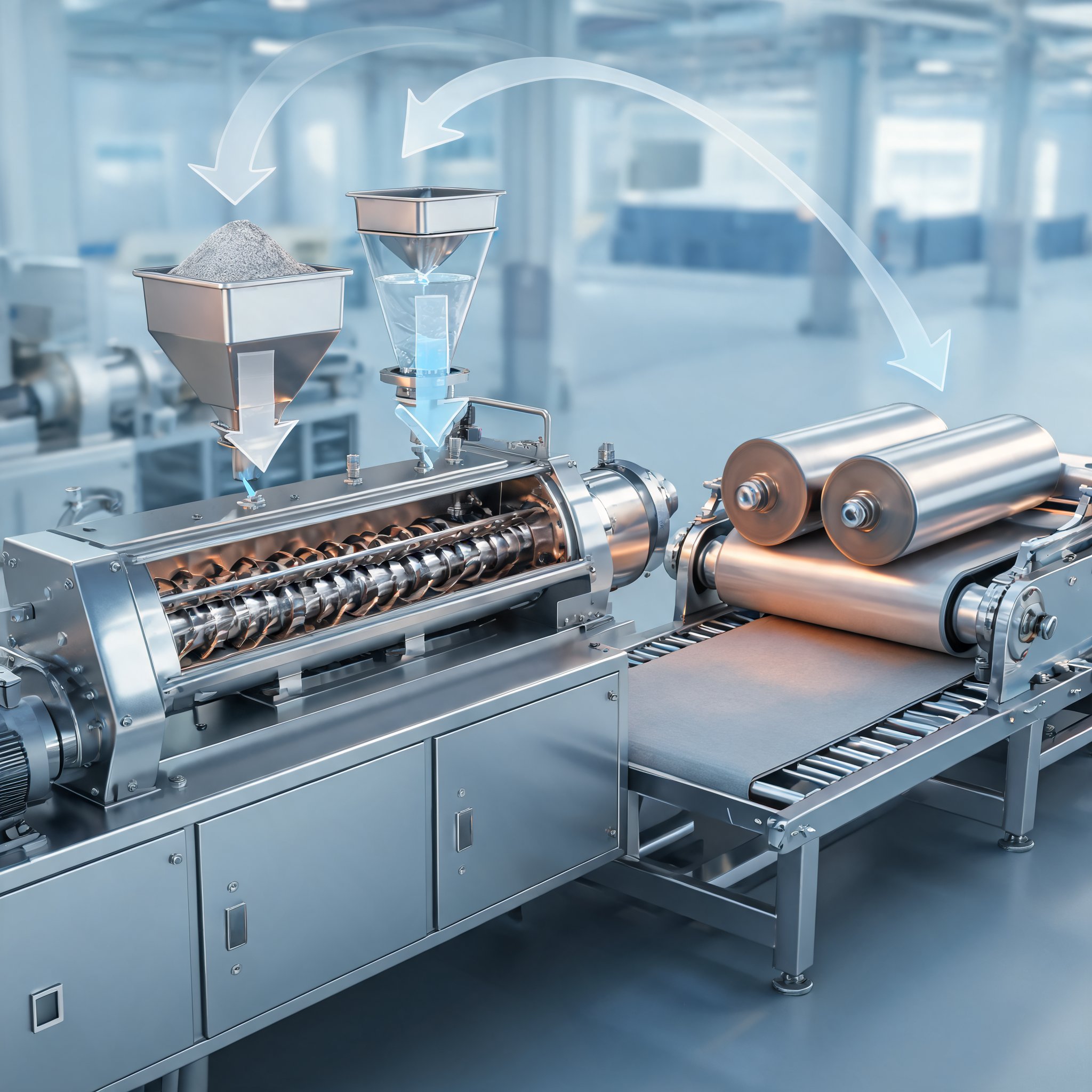
KraussMaffei Extrusion has developed a continuous single-stage process for making PVC roofing membranes, replacing the conventional two-step route that begins with a separate hot-cold mixing operation. The new PVC InlineMixing system feeds solid and liquid components directly into a twin-screw extruder through gravimetric dosing equipment, combining material preparation and extrusion in one line.
In the established two-stage process, PVC powder, plasticizers, additives and fillers are mixed batchwise in a hot-cold mixer to create a dryblend. That blend is cooled, stored and later plasticized in a twin-screw extruder before being formed into membrane. KraussMaffei says its continuous alternative removes the separate mixing stage and heats the material only once.
Cost and footprint implications
According to KraussMaffei, the process can reduce energy consumption and energy costs by up to 75%, depending on the formulation, system parameters and plant location. The company also cites lower capital expenditure because no separate heating-cooling-mixing combination is required, and lower operating costs through reduced space, labor and maintenance requirements. Maintenance savings are linked to the elimination of wear parts used in the hot-cold mixer.
The continuous line is also presented as more flexible than dryblend premixing. Formulation adjustments and color changes can be made during operation through the integrated control system, according to the company. Because separate dryblend batches no longer need to be prepared and stored, those intermediate steps are removed from the production sequence.
Validation and industrial reference
The process was developed at KraussMaffei Extrusion's Technology Center in Laatzen and tested with industrial roofing-membrane formulations. The trials used a co-rotating twin-screw extruder from the ZE 65 BluePower series, equipped with loss-in-weight feeders for all solid components and multiple liquid feeders for free-flowing ingredients. The ZE BluePower series has a Da/Di ratio of 1.65; KraussMaffei says the combination of high torque and large free volume gives a broad process window for different formulations.
The company reports that tests confirmed good PVC gelation and high product quality. Mechanical properties and weldability met industrial requirements across several formulations. Christopher Bartel, Head of Sales Flat & Foam at KraussMaffei Extrusion, said the results indicate the process's potential for industrial roofing-membrane production and that the Technology Center works with customers to test their own formulations under production-relevant conditions, optimize the process and prepare for industrial implementation.
PVC InlineMixing is already in use in an industrial production line for PVC roofing membranes. The reference plant has a total throughput of 1,800 kg/h with two extruders and two calenders. In that line, PVC, additives and fillers, along with edge trimmings generated during production, are processed continuously into finished membranes.
KraussMaffei positions the process as a way to combine product quality with a leaner production route, offering lower cost and greater flexibility for PVC roofing-membrane manufacturers. The reported energy and cost benefits remain dependent on formulation, equipment settings and site conditions, as stated by the company.