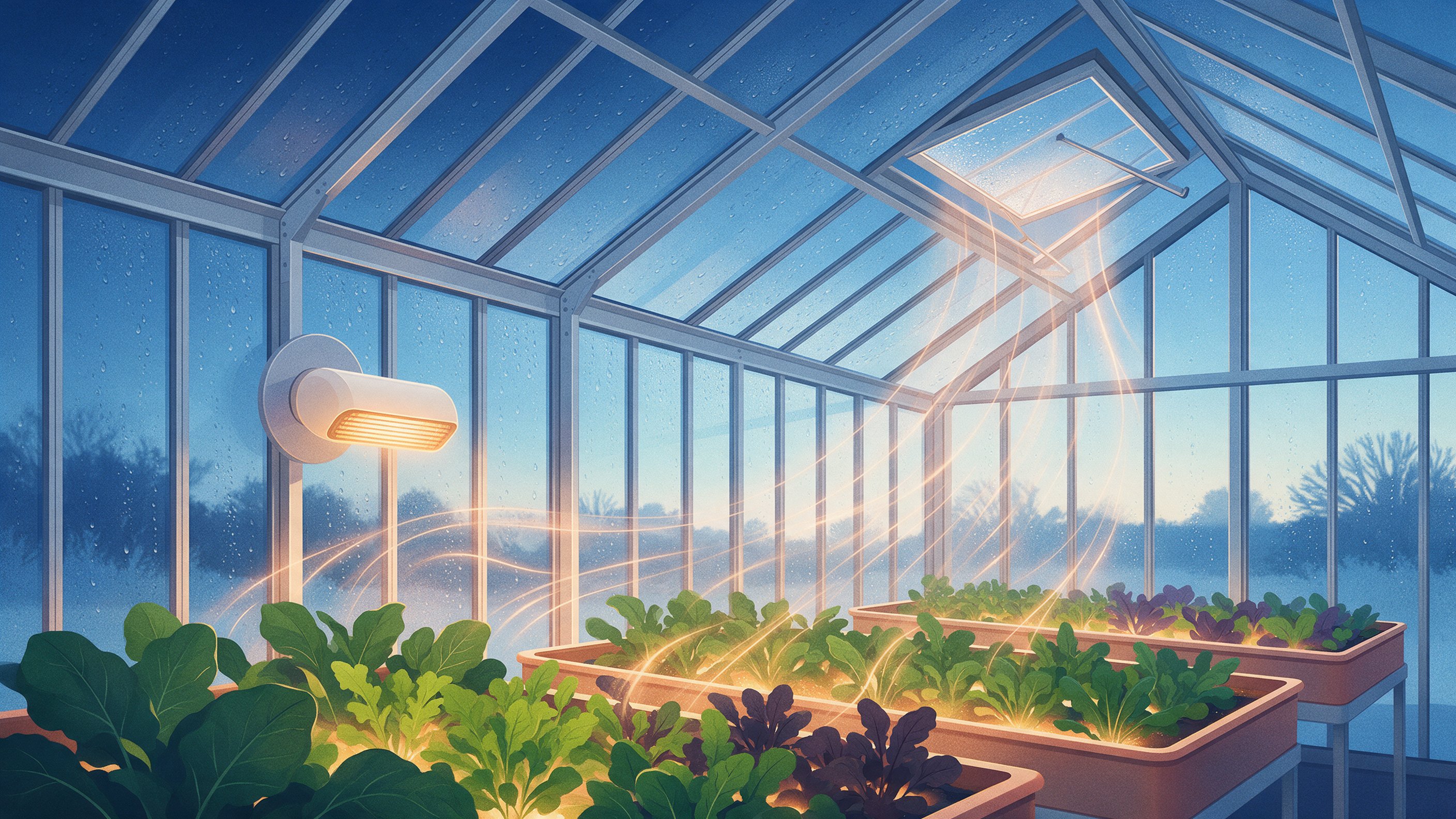
As winter temperatures fall, greenhouse growers face a familiar trade-off: sealing the structure to conserve heat also traps moisture. The result can be condensation on leaves, glazing and structural surfaces, longer leaf-wetness periods and greater disease pressure. The practical goal is less about holding a specific relative-humidity number than about keeping crop surfaces above the dew point.
Relative humidity indicates how close the air is to saturation, but condensation occurs when a surface cools to the dew point. In cool weather, glazing, frames and leaves can be colder than the surrounding air, so moisture forms even when the greenhouse’s general RH reading does not look extreme. That free moisture on foliage is the condition growers need to prevent.
Moisture builds overnight
During the day, crops and growing media release water vapor through evapotranspiration. As temperatures drop overnight, relative humidity rises. In a closed greenhouse, moisture can accumulate, and still air in corners or near curtains may approach saturation by morning. That makes air movement and ventilation important, especially in stagnant zones.
Use heat and vent together
Heating and venting can appear to work against each other, but short coordinated cycles can be effective. Heating raises the air temperature and lowers relative humidity, helping water evaporate from plants and surfaces. A brief venting period then exchanges moist interior air with cooler outside air. Limiting the duration of venting helps avoid unnecessary energy loss and sharp temperature swings.
Even out microclimates
Greenhouse conditions are rarely uniform. Cooler, more humid pockets often develop near sidewalls, doors, corners, curtains and crop canopies. Horizontal airflow fans can mix the air and reduce these differences while helping leaves dry. Because fans move air but do not remove water from the greenhouse, they need to be paired with ventilation when moisture becomes excessive.