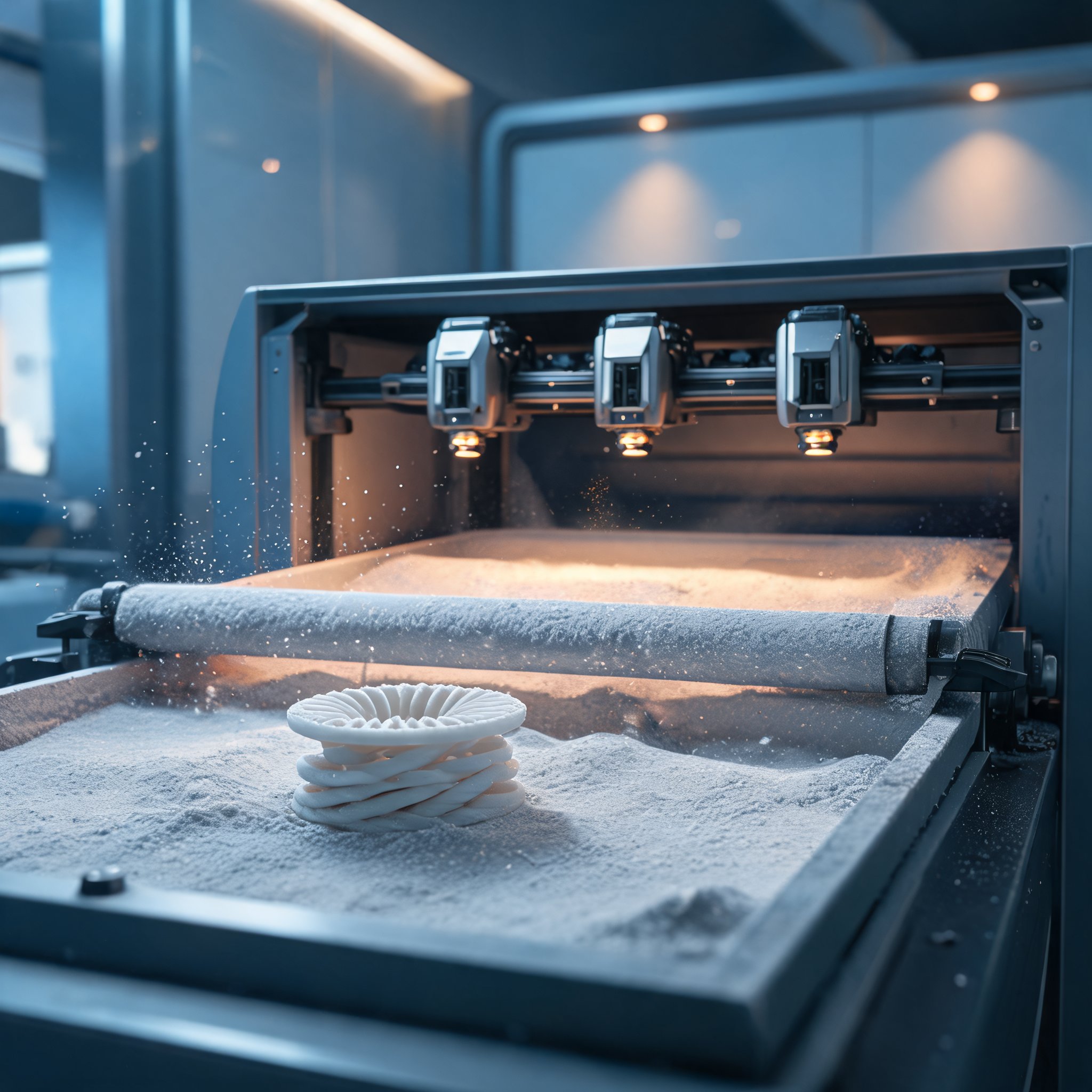
EOS is preparing to introduce a new polymer powder bed fusion platform at Formnext 2026, and at least one customer has already run the unreleased machine in production. Materialise, the additive manufacturing service provider, evaluated the system under real production conditions and reported 44% higher productivity than on the previous EOS platform, together with a build-time reduction of more than six minutes per part.
EOS has not disclosed the full specification of the platform, which is due to be presented in detail on 17 November at Formnext 2026, at the company's booth in hall 12 (D71). What has been confirmed is a three-laser architecture with intelligent laser utilisation and dynamic load balancing. According to EOS, the load balancing "maximizes output per build by equally balancing the exposure workload," while the additional laser capacity raises overall productivity.
Aerospace part used for the trial
For the evaluation, Materialise printed a cable twist wheel for GKN Aerospace. The company said it was interested in more than whether the machine could produce the part — it could — and set out to measure reliability, the effect of the platform's new features, productivity and efficiency, usability and control, and how easy the prints were to post-process.
Giovanni Vleminckx, process engineering manager at Materialise, said the three lasers "make a visible difference in performance," adding that their intelligent utilisation helps the service achieve considerably higher throughput while holding the part quality its customers expect.
The platform also offers extended process controls, letting users work with validated parameter sets or open them up when a specific application or set of KPIs calls for closer alignment. Vleminckx said what stood out was "not one isolated feature, but the overall performance of the system," which he described as combining the productivity the service needs with the process stability and control required to move demanding applications into production.
Measured on the cable twist wheel, productivity rose 44% against the previous machine, and build time per part fell from 19:53 to 13:51 minutes.
Downstream gains in depowdering
Materialise also reported benefits that show up after printing. An advanced roller recoater produces softer powder cakes, which the service provider said makes depowdering easier and reduces handling effort. "The soft powder cake is a very tangible improvement for our operators," Vleminckx said, noting that parts are easier to unpack and clean, which makes the overall workflow noticeably more efficient.
For a manufacturing service with high-throughput requirements that has to adapt to different production applications, the combination of a three-laser architecture, the new roller recoater and open process controls is the relevant package. EOS has not yet detailed the remaining specifications; those are expected at the November unveiling.