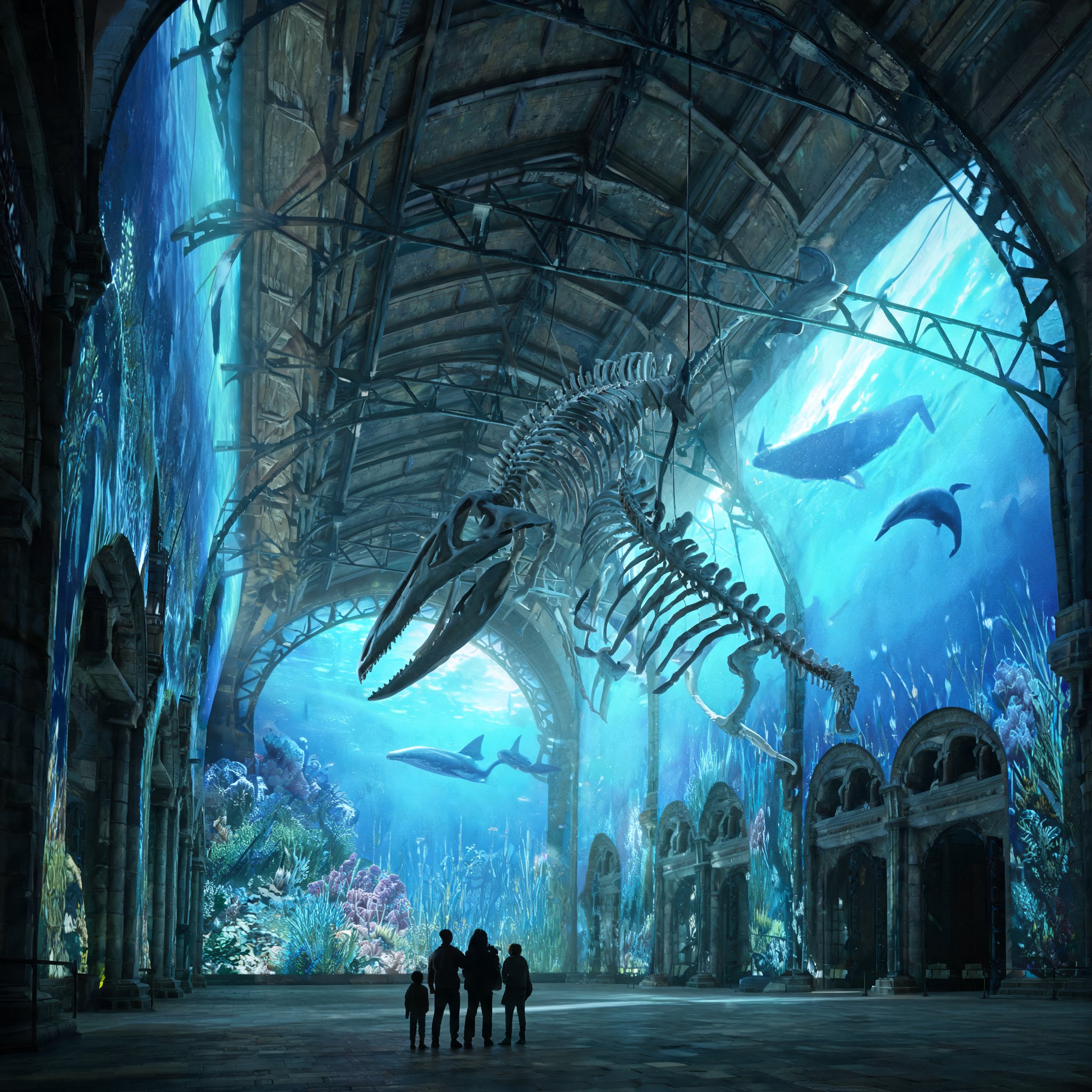
Oceano Odyssey - Mission Pelagos is the flagship experience of the Oceanographic Museum of Monaco's Mediterranean 2050 programme, and it occupies one of the institution's oldest rooms. Rather than installing an immersive show inside the historic Salle de la Baleine, the project turns the century-old gallery into the interior of a scientific research vessel.
The starting ambition, as described by the museum, was not to explain the future of the Mediterranean but to let visitors experience a future worth protecting. Instead of dwelling on environmental decline, the exhibition places audiences inside a scientifically credible vision of a Mediterranean in which long-term conservation has succeeded. That shift from warning to possibility, its authors say, shaped the design throughout.
Architecture as part of the narrative
The hall's monumental architecture and suspended marine skeletons are not screened off by technology. Projection mapping, sound and scenography are used to reveal the existing building rather than compete with it, so the heritage setting functions as an element of the story instead of a backdrop. The approach is presented as evidence that immersive design can work inside an iconic cultural space without erasing its identity.
A shared, device-free journey
The visitor experience was built as a collective one. Oceano Odyssey avoids headsets and individual devices, bringing families, school groups and international audiences through the same environment at the same time. Guided by a fictional Captain Anita and her crew, visitors join a scientific expedition that passes through seagrass meadows, coral habitats, deep canyons and open water populated by dolphins, fin whales, sperm whales and more than thirty Mediterranean species. The intention is that science is encountered through exploration rather than delivered only through interpretation.
Science inside the creative process
The museum's scientific teams were involved from the earliest stages of development, working alongside designers, writers and digital artists across the project. According to the institution, scientific knowledge did not simply validate the exhibition once it had been conceived; it informed the narrative, the shape and behaviour of the marine species, the reconstruction of habitats and the overall visitor experience.
A mezzanine level extends the same logic to the collection. There, visitors meet the museum's scientific collections devoted to the Mediterranean, setting contemporary digital storytelling alongside more than a century of research and observation. The exhibition treats immersive media and authentic collections as mutually reinforcing rather than separate offers.
Reversible installation and a digital ecosystem
Delivering the concept required a fully reversible installation carrying more than 310 m² of projection mapping, synchronised through integrated Medialon show control and Modulo Pi media server architecture. The technical ambition is considerable, but the stated aim is that visitors barely notice it: technology exists to sustain the illusion rather than to become the attraction.
Built in Unreal Engine, the digital environment recreates a scientifically informed Mediterranean ecosystem covering 300 km². It brings together more than 866,000 digital assets and over thirty Mediterranean species, developed in close collaboration with the museum's scientific teams.
The project's organisers frame its novelty less in the individual ingredients — heritage, science, technology and storytelling — than in their integration under a single design and aesthetic philosophy, in which each decision serves the translation of scientific knowledge into a shared cultural experience. On that account, Oceano Odyssey is offered as a model for exhibitions in which immersive design supports a museum's educational mission, adds value to its architecture and casts visitors as participants in the future they wish to protect.