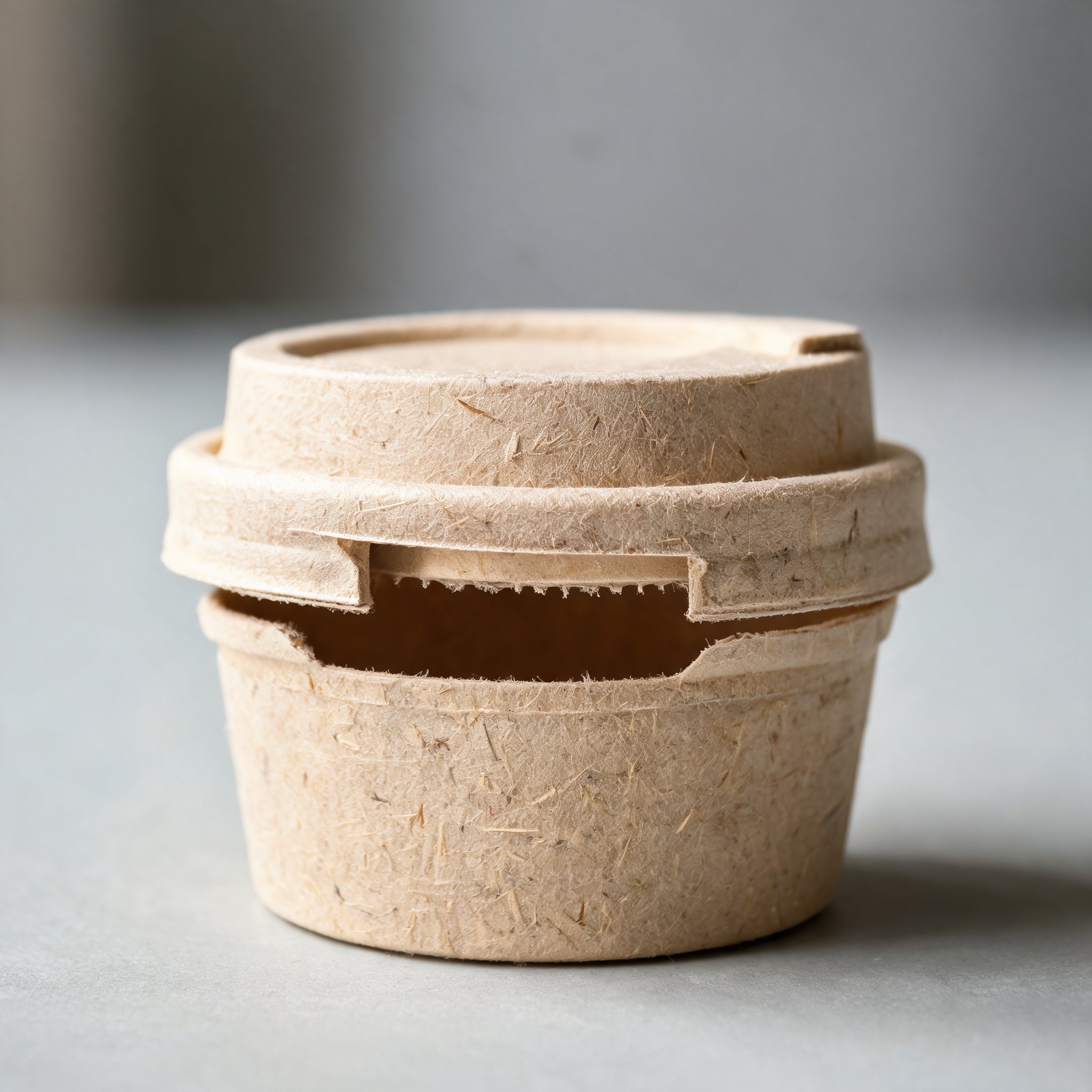
Yangi has added an undercut feature to its dry-forming platform for moulded fibre packaging, aiming to help customers replace plastic components such as coffee lids with fibre-based parts.
Undercut geometries are used in plastic packaging for snap-fit connections and secure closures, creating a reliable mechanical fit between a lid and container. Yangi says the format is technically challenging in moulded fibre applications.
Coffee lid demonstration
The company is showing the capability through a coffee lid. A precision-engineered undercut is said to provide a secure, consistent fit with a measured lid removal force of 6 N.
Yangi tested the lid through 10 simulated coffee pours over 10 minutes. It reports that the lid maintained a leak-tight seal and structural integrity when exposed to hot beverages at 93°C.
The undercut technology is also suitable for fitted closures in snack containers, takeaway containers, dessert and ice cream tubs, confectionery packaging, dry and ambient food containers, and packaging for personal care products, cosmetics and consumer goods.
Cellera platform
The undercut capability builds on Cellera, a dry-forming platform powered by Yangi’s patented fibre formation system, FiberIQ. Unlike conventional wet moulding, Cellera forms fibre without a water-based forming step. Yangi expects this to reduce water and energy requirements in the production of renewable, fibre-based packaging.
In a coffee lid application, Cellera’s four-second production cycle is estimated to reach an output of 300 lids per minute. The platform is designed for high-volume, cost-competitive manufacturing, combining precise fibre distribution with advanced forming technology for consistent quality and functional performance, according to the company.
Executive comment
Carlo Semeraro, head of commercial partnerships at Yangi, said achieving this level of precision in dry-moulded fibre requires advanced tooling and forming expertise. He said the coffee lid demonstrates the performance Yangi can deliver today, but the larger opportunity is to apply the functionality to a much wider range of packaging applications.
CEO Johann Kaiser said the challenge has never been simply to replace plastic with fibre, but to make fibre perform at the level the market demands. Each new capability reinforces fibre’s position as a competitive alternative to plastic by delivering the functionality, quality and industrial performance needed to support the transition toward fibre-based packaging, he said.
Showcase and scale-up
Yangi will display the undercut feature alongside other additions to its dry-moulded fibre packaging range at the Sustainable Packaging Summit in Utrecht from 10 to 12 November 2026. Attendees can visit Stand 28 in the Networking Zone to view Cellera dry-forming technology through an immersive VR experience.
The announcement follows Yangi’s announcement of the commissioning of its serial Cellera machine platform. Combining Cellera with the dry-forming process is set to reduce resource consumption and CO2 emissions by 70%–80% compared with conventional plastic alternatives, according to the company.
Separately, PulPac licensee Hébert Group has partnered with Andritz to scale up production of Dry Molded Fiber trays and lids. The partners are targeting water- and energy-efficient manufacturing using renewable or recycled fibres.