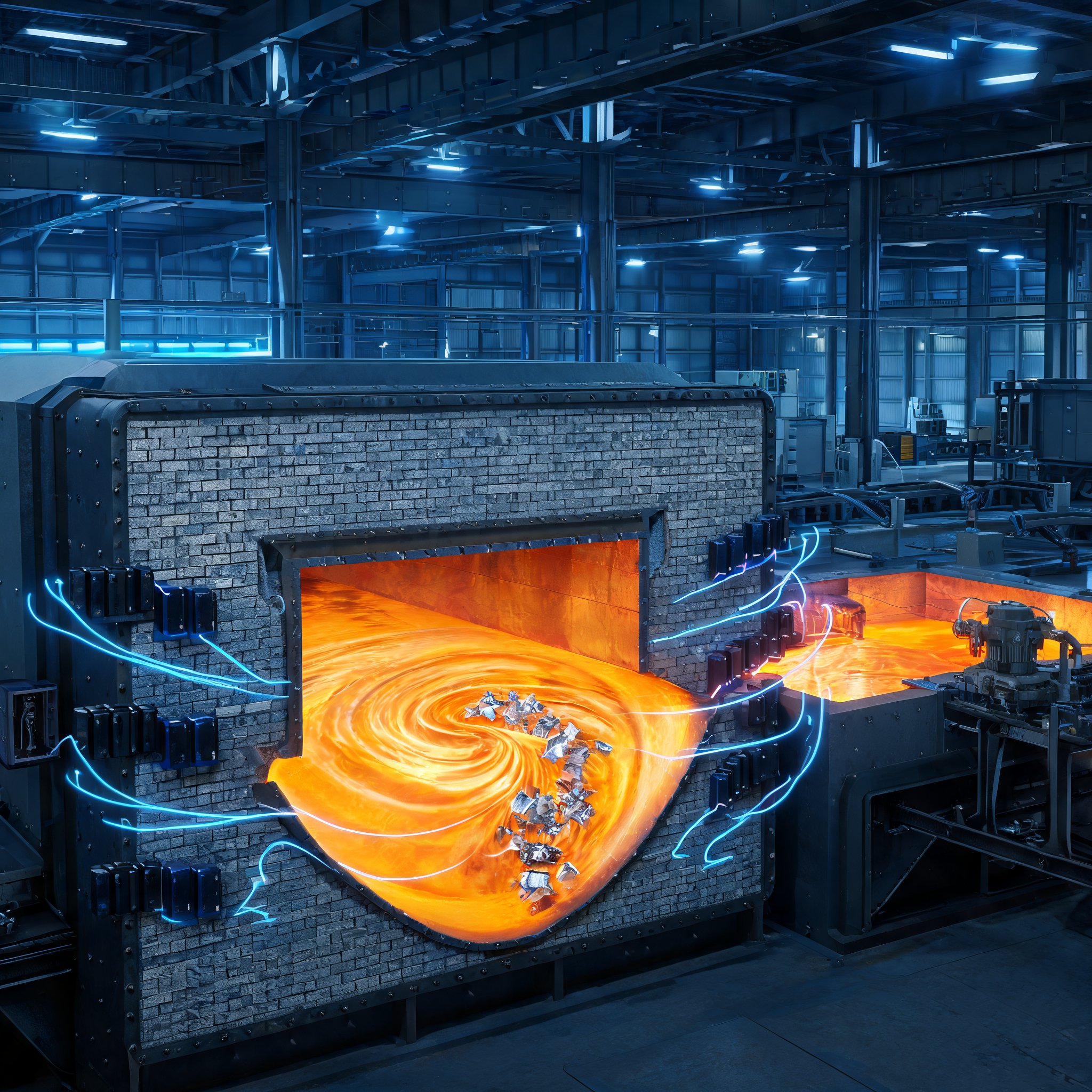
Aluminum casthouses are trying to use more recycled metal without compromising melt quality, recovery rates or production efficiency. As more post-consumer recycled aluminum is added, lightweight scrap, machining chips and other low-density materials become difficult to introduce into conventional melting furnaces. Zmag America, Ltd. presents permanent-magnet engineering as a way to address scrap feeding, melt circulation and furnace stirring without immersed mechanical impellers.
Zmag’s technology is based on industrial magnets and magnetic circuits. The company traces its history to magnetic engineering and commercialization of eddy-current separation, which recovers non-ferrous metals from mixed streams. It later moved into molten-metal applications and developed its patented zPMC permanent magnetic circuit, the foundation for equipment that stirs, circulates and submerges material in molten aluminum.
The company distinguishes its approach from conventional electromagnetic stirring. Zmag’s zPMC system uses a permanent magnetic circuit to create the magnetic field that moves the molten metal. Zmag calls the movement a “virtual impeller,” generating circulation without conventional immersed mechanical impellers. In an August 2025 interview, Zmag America President Eishin Takahashi identified limited familiarity with the technology as a barrier to wider U.S. adoption, saying aluminum producers globally tend to be conservative and more comfortable with equipment and processes they already know.
MagStir and MagPump
MagStir is a non-contact stirring system for aluminum melting and holding furnaces. It uses the permanent magnetic circuit to move the molten bath and support homogenization of temperature and alloy composition. Zmag offers configurations for furnaces from 15 to 200 metric tons. Because it has no immersed mechanical stirring component, the company presents it as an alternative for casthouses that want better melt circulation without adding moving parts to the molten-metal environment.
The technology has been installed outside the United States. New Zealand Aluminium Smelters fitted MagStir in a casting furnace and later extended its use to additional furnaces; a 2017 case study reported improvements in temperature control during furnace preparation. Rio Tinto’s Boyne Smelters in Queensland, Australia, installed a MagStir unit on a casthouse furnace in 2019.
MagPump extends the same magnetic approach to molten-metal pumping and circulation. Zmag says the system fits a standard pump well without furnace modification. It has no physical impeller and is marketed as a nearly hands-free option with no consumable parts and minimal downtime. At the TANDEM Division of TST Inc. in Fontana, California, a seven-week trial replaced an existing mechanical pump. Zmag reported smooth operation and reduced disturbance to the molten-metal surface; TST plant management reported that the system avoided the splashing seen with conventional pumping as furnace metal level fell during draining. A TMS 2023 presentation also covered use in side-well, multi-chamber furnaces and potential for gas injection and scrap submergence.
Typhoon targets low-density scrap
Zmag’s Typhoon system focuses on scrap submergence and chip melting. It is designed to introduce lightweight aluminum scrap and machining chips below the molten-metal surface rather than leaving them floating at the top. Its magnetic circuit generates a vortex-like movement that draws material into the melt and supports heat exchange and recovery during remelting.
Neuman Aluminium incorporated a Typhoon chip-submergence system into its Marktl, Austria, furnace modernization to process more low-density post-consumer scrap. The targeted material had a bulk density of about 375 kg/m³ and had been difficult to charge and melt in conventional equipment. Neuman set a target of processing one metric ton per hour while continuing to melt solid charge in the same furnace. Zmag reported Typhoon processed almost twice the planned scrap quantity in the expected time without disrupting operations, with low operator involvement and no reported negative impact on melt or finished-product quality.
According to the published technical account, Typhoon operates at 5–15 kW, including its air-cooling blower, and can submerge up to five metric tons per hour of machining chips. Its vortex intensity can be adjusted to suit operating requirements, allowing it to maintain molten-metal movement when scrap or alloying material is not being charged.
A competitive field
Zmag is not alone in supplying furnace stirring, molten-metal circulation and scrap-submergence equipment. ABB offers its AL-EMS electromagnetic stirring system for aluminum melting, holding and alloying furnaces and reports more than 430 installations; in April 2026 it announced an Arconic order for a fifth stirrer at a Hungarian casthouse. Presezzi Extrusion Group’s Melting Technology division offers the L.E.C. low-energy-consumption stirrer for melting and holding furnaces, along with remelting and casthouse equipment. Pyrotek supplies electromagnetic pump systems and LOTUSS low-turbulence scrap submergence, which uses a circulation pump and refractory well to submerge lightweight scrap. Rockwell Automation works in adjacent automation, including furnace and ladle-shop controls, not a like-for-like permanent-magnet stirrer.
The comparison matters as casthouses try to use more challenging recycled feedstock. If producers need to manage molten-metal movement without conventional immersed mechanical components, permanent-magnet systems could become more relevant, though adoption will depend on familiarity, operating experience and site-specific needs.